Friday, January 25, 2008

Frankenstein Created Woman (1967)


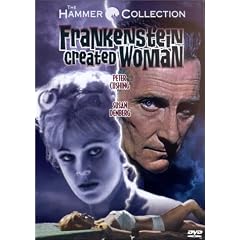
My Hammer watching continues. I believe this was the fourth Frankenstein film Hammer did following Curse, Revenge and Evil. Peter Cushing reprises his role as the Baron and his introduction in the film is awesome. The plot is complicated, but well crafted into a great revenge tale. Susan Denberg plays the new creation, but does not appear until the last third of the film. The guillotine on the hill used throughout the tale is a striking image.

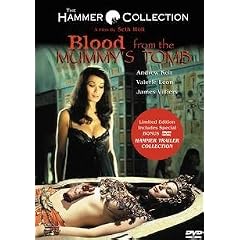
Blood from the Mummy's Tomb (1971)


Blood from the Mummy's Tomb was the final mummy picture Hammer did. The beautiful Valerie Leon stars as Margaret Fuchs, whose life is intertwined with Queen Tera of Egypt, also portrayed by Valerie Leon. Peter Cushing was supposed to play the role of her father, but his wife's illness at the time caused him to drop out.

The movie is well done and I like the cosmic feel of the images and story. The story is based on a novel by Bram Stoker entitled Jewel of the Seven Stars, which I am not familiar with. The small featurette on the DVD mentions the producers forcing them to have the mummy word in the title and their difficulty in finding a suitable title for the film.

Director Seth Holt died suddenly near the end of filming, casting another dark shadow on the period of the film coupled with Cushing's departure.

Monday, January 21, 2008

Popol Vuh - "Aguirre II"

My introduction to German progressive band Popol Vuh was through Opeth's The Roundhouse Tapes, a live recording released late last year. The concert opens with a song from Popol Vuh's soundtrack to Werner Herzog's Nosferatu film, which I have yet to see.

I found a Popol Vuh MySpace page a week or so ago and the first track on there, "Aguirre II," began. A haunting mellotron opens the song and the guitar just blossoms into one of the most beautiful pieces of music I have ever heard. I ordered the album immediately.

I think everyone has special songs that touch their heart and soul and this track is one of those for me. I spend a good bit of time listening to song samples looking for bands or songs with that special feeling for me and the payoff in finding a nugget like this is such a reward that keeps me searching.

The CD has yet to appear in my mailbox, so I have been coming to the website to listen to "Aguirre II" over and over. Take a few minutes out of your day and listen to it.

Sunday, January 20, 2008

Black Widow - Sacrifice (1970)

The first album by UK's Black Widow arrived yesterday and received several repeated listenings.


Black Widow's lyrics are full of black magic. Their stage show even included a mock sacrifice of a woman! While their lyrics may make Black Sabbath pale in comparison, the music is a strange brew of rock and unlikely elements rather than the overdriven blues Tony Iommi and crew were laying down.

The album opens with "In Ancient Days." A slight organ stab kicks off the album almost like a Scooby Doo, Where Are You? musical cue before building into a mournful organ solo ending with a horrific kaleidoscope of tones. An acoustic guitar begins to strum leading the drums into a surreal atmosphere where a smooth saxophone enters. The band grooves under the verse and you will definitely find yourself humming "I conjure thee, I conjure thee, I conjure thee!"

Uplifting acoustic strumming begins "Way to Power." The bombastic drums enter into a Who-like song. The horns really fit into Black Widow's style.

"Come to the Sabbat" open with tribal drums, flute, and chanting sounding more Native American than devilish. Then, the song turns into a great Jethro Tull style track with a chanting chorus that will ring in your head all day: "Come, come, come to the sabbat, come to the sabbat, Satan's there!"

Cymbal washes fade into "Conjuration." The guitars begin just like Roy Orbison's classic "Running Scared," which surprised me at first. It soon builds into a floating track with those beautiful horns returning to give it an ethereal quality.

"Seduction" begins with vocals and a wah guitar. Strings enter and create a relaxing atmosphere much like the previous track. At about two minutes into this track, the music changes and sounds like opening title music to a 1970s Italian giallo fillm for a while before returning to the opening style.

"Attack of the Demon" is a faster paced organ rocker with yet another great chorus that will be stuck in your head: "All of my sins have left me in hell" with a underlying "Nah nah nah nah."

The final track is "Sacrifice." A fantastic drum fill opens this driving rocker complete with organ and flute. Between verses, there are these great sing-along "Yeah-eah-eah" chants. The songs goes into a little drum and bass breakdown for flute solos that would make Ian Anderson and Rob Burgundy proud. Next, the pace picks up and it's the organ's turn to improvise before returning to the opening groove and bringing it home.

The album is one of those you expect to like as an okay record after the initial play, but it starts to grow on you with each listen. The lyrics are fun and there are lots of great hooks that'll get stuck in your head.

The Repertoire Records CD includes the "Come to the Sabbat" single edit, which excises the opening tribal drums and chanting.

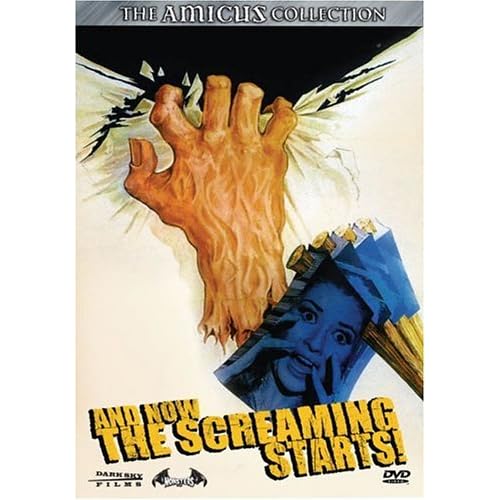
And Now the Screaming Starts! (1973)

Amicus arose to compete with Hammer's horror films, even borrowing many of Hammer's familiar faces such as Christopher Lee and, in this case, Peter Cushing.

And Now the Screaming Starts! stars Stephanie Beacham as Catharine Fengriffen, who played Van Helsing's ancestor in Hammer's groovy Dracula A.D. 1972 the year before. She moves into her newlywed husbands' family's castle at the beginning of the film. Unfortunately, she begins to see visions linked to a painting in the castle. The visions include a severed hand not unlike the severed hand haunting Christopher Lee in Amicus' Dr. Terror's House of Horrors in the early 1960s. Her counterpart vision is a man missing a hand and missing eyes with rivulets of blood streaming from the empty sockets.

To complicate things, she has become pregnant. Her mental health deteriorates and she is suspicious of the local woodsman. The legendary Peter Cushing finally appears halfway through the film as a psychiatrist to help her through the recomendation of her physician played by Patrick Magee. The mysteries slowly become uncovered and a curse is revealed involving actor Herbert Lom in a flashback sequence.

The film kind of drags a little until Cushing's onscreen presence reinvigorates the story and his character works to unravel what is happening to her.

Thursday, January 17, 2008

T2 and November

Today's playlist consisted of two early '70s albums.

---

T2 - It'll All Work Out in Boomland (1970)


T2 formed in the UK and released this fine album in 1970 when guitarist Keith Cross was only 17 years old. Within their first year together, the band split up. Drummer and vocalist Peter Dunton gathered new musicians and continued T2 in 1971 and 1972.

"No More White Horses" is the standout track opening with a repeating, descending guitar riff. The bass guitar joins in followed by the drums, which crescendo into a guitar solo thick with Neil Young abandon. The song becomes quiet and a beautiful little horn section comes in to add even more emotion to the rock elements. This is a moody classic that deserves attention.

The album has three other tracks. "In Circles," the opener, is a solid rocker with a killer verse riff. "J.L.T." is a mellow track with piano and some Zappa-esque melodies and voicings. "Morning" tops out at 21 minutes and journeys through acoustic atmospheres, grandiose rock, and small progressive rock moments obligatory to any side-spanning track.

Keith Cross' savage guitar work is lovingly sprinkled throughout the whole record in all the correct places.

---

November - 2:a (1971)


Sweden's heavy November had a short lifespan as well (approximately 1970-1973), though in 2007 they regrouped for some live shows. I really think the only reason for their obscurity, especially in the US, is their lyrics are in their native tongue. These guys were heavy. These guys were groovy.

"Sista Resan" opens the album with a quiet piano and beautiful Gilmour-esque guitar solos. Friends, this is how you open an album.

"Men Mitt Hjarta Ska Vara Gjort Av Sten" starts the engine and opens into a Sabbathy groove. The groove eats itself and vomits forth a new groove. Two grooves for the price of one.

"Asthamahgurchk - Den Fjottegangere" is a short vocal sound experiment that calls to mind Pink Floyd's "Several Species of Small Furry Animals Gathered Together in a Cave and Grooving with a Pict."

"Mina Fotspar Fylls Av Vatten" is a heavy, rockin' blues number with some tasteful double-bass drumming.

"En Lang Dag Ar Over" begins with a bass riff and moves into a dark, gentle song with rolling toms.

After the softer number, "Mouchkta (Drommen Om Malin)" erupts into a great head bobbing groove.

"Pa Vag" starts out as a slow, heavy song, but busts into a raucous shuffle midway before returning to the Earth rumbling groove.

"Ganska Langt Fran Sergel" has a evil, spidery riff. Plain sinister. The later part of the track is a percussion extravaganza that'll have you cranking it to eleven.

Beautiful piano, guitar, and cymbal washes dominate the instrumental "Och Sa En Morgon."

"En Ny Tid Ar Har" quickly builds up to a rockin' shuffle with a sing-along vocal.

2:a's songs are put together in the perfect order for a fantastic listening experience.
Wednesday, January 16, 2008

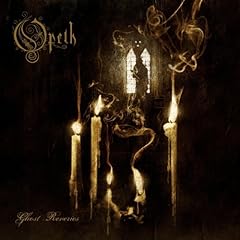
Opeth - Ghost Reveries (2005)

One album that has stayed by my side for months and months is Ghost Reveries by Sweden's Opeth.


My first Opeth album was Damnation. I bought in in 2003 on a whim. Unbeknown to me at the time, Damnation was the new clean, mellow record recorded during the same sessions for 2002's metallic Deliverance. Damnation made an instant fan out of me. Finally, here was an album full of the 1970s progressive melancholy tones I loved in a modern form.

Over the next several months, I picked up Opeth's back catalog of metal recordings. Their 2004 live DVD was amazing and the accompanying documentary on Deliverance/Damnation was great.

Ghost Reveries came out in 2005 and I nabbed it on release day...the rabid fan I am. I cannot fathom this album is two years old in hindsight. I have carried it with me on most trips and the disc has more miles in my car than any other passenger these past few years.

The haunting sighs of the opening "Ghosts of Perdition" infest the mind. I frequently find it humming somewhere in my the back of my head.

"The Baying of the Hounds" is the best Opeth song. The sprawling epic begins with a charging Uriah Heep groove and gives away to a positive vibe and punishing instrumentality. The journey moves into a bass and drum driven meditation before the raging guitars return. The song continues to build to a pummeling crescendo until the cathartic climax opens the ears with beautiful acoustic melodies and atmosphere. The section truly sounds like being in some kind of angelic presence and it touches me EVERY single time I hear it.

"Beneath the Mire," "Atonement," and "Reverie/Harlequin Forest" continue the lush metallic symphony and bring the listener to the somber and introspective "Hours of Wealth."

"Hours of Wealth" instrumentally builds to sweeping mellotrons and drops to Mikael Akerfeldt's stripped down vocals and guitar. The song ends with a gorgeous David Gilmour-esque solo.

"Hours of Wealth" is the calm before the storm of "The Grand Conjuration" much in the way "Mood for a Day" clears the way for the onslaught of "Heart of the Sunrise" on Yes' classic Fragile album. "The Grand Conjuration" is one of those rare songs whose title really says it all. The sinister track is full of aggression. The final song, "Isolation Years," sounds like the end of the war and is a fitting, quiet closer for this masterpiece.

The 2006 re-release of Ghost Reveries includes their cover of Deep Purple's ballad "Soldiers of Fortune," which is top notch.


This spring, Opeth will release a new album and it makes me feel neato.